
REIDA (Real Estate Investment Data Association) is a non-profit association of around 30 players in the real estate industry that is committed to transparency. While the association has been setting standards for financial data for years, the CO₂ benchmark has become firmly established as a standardized methodology for calculating environmental indicators.
What is the REIDA CO₂ benchmark and the REIDA CO₂e report?
The REIDA CO₂ benchmark is based on a standardized, nationally recognized methodology for calculating environmentally relevant KPIs. The aggregated benchmark values from all participating portfolios are public; benchmark participants also receive a REIDA CO₂e report for their own portfolio. Find out more at reida.ch.
Advantages of participation:
- Comparability of your own portfolio with the market
- Transparency for owners, investors and other stakeholders
- Use of the same KPIs required by AMAS, KGAST and ASIP
- Possibility to have a CO2e report prepared for your own portfolio several times a year in order to analyze progress or deviations in a timely manner
- Introduction of a clean reporting process in the organization based on a national standard
Data is delivered annually, with two key dates:
- End of July: Registration for benchmark participation
- Mid-September: delivery of the data
What data is required?
Data input for the report is usually carried out using a structured Excel template, which is divided into four main areas.
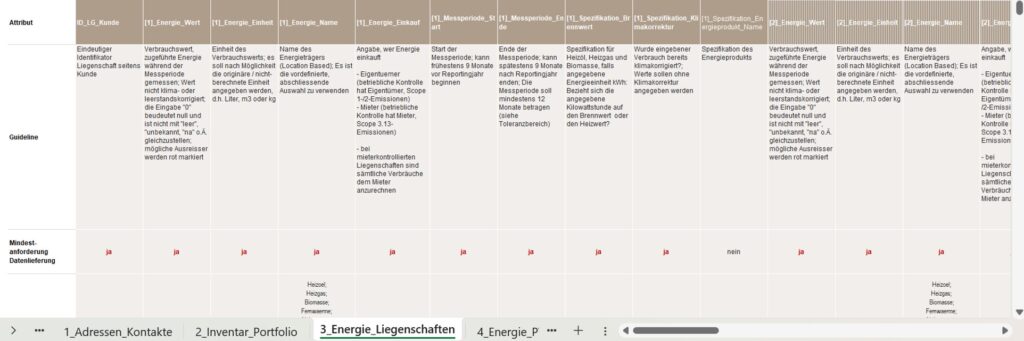
1. Portfolio and inventory data
In addition to general information on the portfolio, specific master data must be recorded for each property:
- Address and year of construction as well as the year of the last energy refurbishment.
- Status of the property: Differentiation between existing, new construction, replacement new construction or properties undergoing complete renovation.
- Transactions: Documentation of purchases or sales during the reporting year.
2. Area data
REIDA primarily refers to the rentable area, broken down by type of use. Optionally, the energy reference area or the floor area according to SIA can also be specified.
3. Energy data
Energy data is at the heart of REIDA data entry. Ideally, consumption must be recorded for a period of 12 months for each property and energy source. REIDA also accepts periods of 11 months for the purposes of coverage.
4. Energy production
Optional information on the solar power produced can be provided. For this purpose, production and the share of own consumption in production are recorded.
Alphaprop supports owners in collecting energy data and preparing it for REIDA data entry
- Collection of energy data (e.g. automated reading of invoice data using AI)
- Calculation of environmentally relevant KPIs according to AMAS/KGAST
- Preparing the data for participation in the REIDA CO2 benchmark (filling the REIDA template)
- Calculating the CO2 reduction path on the basis of a refurbishment plan
- Preparation of the data in an interactive analysis dashboard
Preparation of raw data
1. Data collection
As a rule, the energy data comes from one of three common sources:
- Intelligent metering systems (e.g. smart meters): The most modern method in which meters automatically transmit consumption data to a system.
- Customer portals of energy suppliers: Many energy suppliers now offer digital interfaces or exports via which consumption data can be obtained directly.
- Energy bills: The most common method is still billing. This can be done manually or automated through the use of AI-supported algorithms
Large portfolios in particular require a great deal of coordination, as management and suppliers are usually organized on a decentralized basis.
2. Harmonization and preparation of data
Once the raw data has been recorded, it must be harmonized and checked for plausibility and assigned to the correct meters for each property. A key step in the onboarding process is the creation of a metering concept. This involves defining the specific measuring points for each energy source for each property to ensure that the data can be assigned seamlessly.
Specialized energy data management platforms such as co2lect also enable automated data quality checks. This checks whether:
- duplicates are present.
- there are input errors (e.g. misplaced commas).
- The data is plausible and complete.
3. Filling of the REIDA template and generation of further end products
Once the data has been properly prepared, the REIDA template can be automatically filled with a single click. Thanks to the structured data preparation, the same data can be used for:
- the calculation of AMAS, KGAST and ASIP KPIs
- internal ESG dashboards
- Strategic CO₂ reduction paths
- Reporting and annual reports
This creates a continuous data flow that generates added value well beyond the REIDA report.
Typical challenges in data collection
Heterogeneous data sources: The data collection process is often characterized by different data sources. Electricity billing works differently to recording oil levels and oil deliveries.
Coordination with different players: Owners often work with different management companies that are responsible for energy data billing. The bills also come from several energy companies. This requires a great deal of coordination.
Special properties: Individual properties require more attention and plausibility checks, e.g. properties with special uses, properties in co-ownership or properties with different energy sources.
The REIDA CO₂ benchmark forms the basis for transparent preparation of sustainability data and is now a central component of sustainability reporting. Through automation and clear processes, the initial effort can be transformed into long-term added value.