
Summary
- Regulatory Framework as a Driver: The Climate Protection Act (KIG) sets the pace—the goal is net-zero by 2050. For the building sector, this means, as a first step, reducing greenhouse gas emissions by 82% by 2040 (compared to 1990).
- The emission reduction pathway—more than just a line: An emission reduction pathway forecasts the trend in emissions intensity as the sector moves toward the net-zero goal. The current focus is primarily on operational considerations (Scope 1 and 2 emissions).
- From Assessing the Current Situation to Implementation: The foundation of any emissions reduction pathway is a robust data set used to determine the current status. The key measures for achieving these goals include replacing fossil-fuel-based heating systems, retrofitting the building envelope, and optimizing building operations.
- Stranded Assets and Reference Paths: Reference paths (such as CRREM) serve as a guide. If an asset exceeds this reference value, it risks becoming a “stranded asset”—a key factor in prioritizing remediation measures.
The transformation of Switzerland’s real estate portfolio toward net-zero is in full swing. Driven by regulatory requirements such as the Climate Protection Act (KIG) and the demands of investors and tenants, the sustainability strategy is taking center stage in portfolio management.
The Starting Point: Regulatory Requirements and Value Preservation as Drivers
Why is there currently so much focus on CO2 reduction pathways? The legal framework sets clear guidelines. The Federal Act on Climate Protection Goals, Innovation, and Strengthening Energy Security (KIG) has been in effect since January 2025. Switzerland has thereby committed to achieving net-zero emissions by 2050. For the building sector, Article 4 mandates an 82 percent reduction by 2040 compared to 1990 levels.
In addition to legal requirements, preserving property value plays an important role. Ensuring that properties are developed in accordance with legal requirements is part of risk management and the duty of care as an asset manager. Only by preventing a backlog of renovations can the value of the properties be preserved.
What exactly is a lowering path?
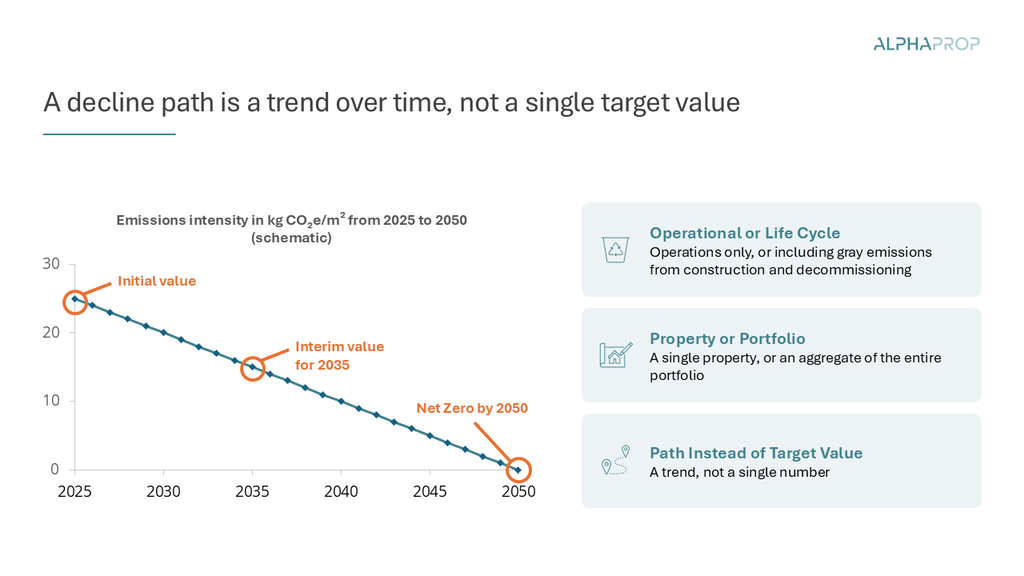
The reduction pathway is the projected trend in emissions intensity over time leading up to the 2050 net-zero target. It is important to distinguish between:
- Operational vs. Life Cycle: The focus is currently mostly on the operational perspective, i.e. Scope 1 and Scope 2 emissions and potentially Scope 3.13 (tenant energy consumption in leased spaces). Including embodied emissions from construction and demolition (also Scope 3) is still voluntary under common industry standards (e.g. AMAS, KGAST).
- Asset vs. Portfolio: The portfolio reduction path is ultimately the aggregation of the individual asset reduction paths.
A reduction pathway is therefore a projection and should be distinguished from binding targets.
Alphaprop supports owners in collecting energy data and preparing it for REIDA data entry
- Collection of energy data (e.g. automated reading of invoice data using AI)
- Calculation of environmentally relevant KPIs according to AMAS/KGAST
- Preparing the data for participation in the REIDA CO2 benchmark (filling the REIDA template)
- Calculating the CO2 reduction path on the basis of a refurbishment plan
- Preparation of the data in an interactive analysis dashboard
The Path to the Reduction Strategy: Three Steps to a Strategy
1. Assessing the Current Situation: The Current State
All ESG reporting begins with a robust data foundation. Accurate tracking of energy consumption, differentiation between energy sources, and knowledge of energy-consumption areas are essential for calculating greenhouse gas emissions (Scope 1 and 2) and establishing the starting point for the reduction trajectory.
2. Guidance: The Reference Path and “Stranded Assets”
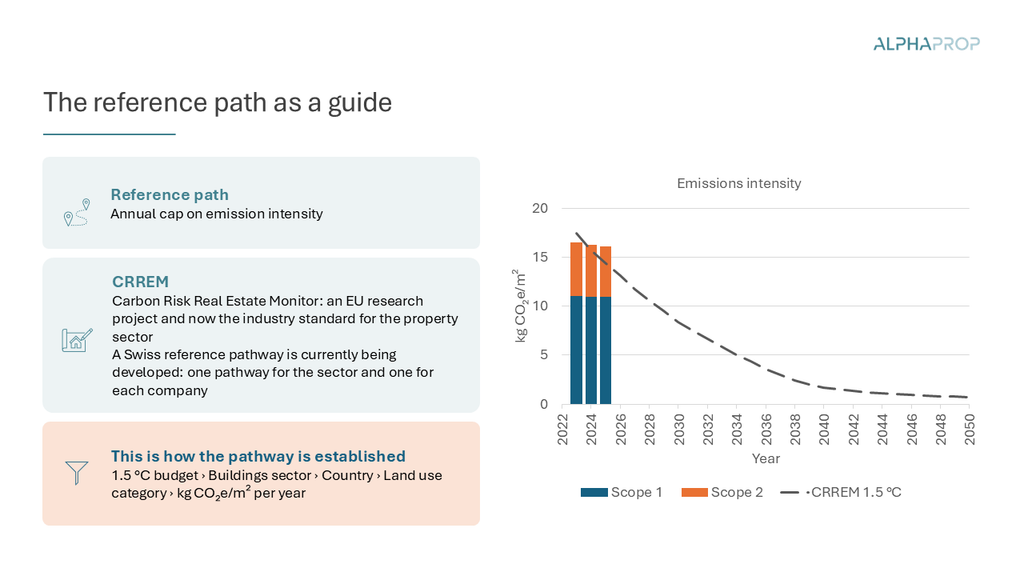
Reference pathways serve as benchmarks for assessing one’s own progress. They define the annual upper limit for permissible emissions intensity so as not to jeopardize a specific climate scenario (e.g., the 1.5-degree target). One internationally established standard is the Carbon Risk Real Estate Monitor (CRREM).
If an asset’s emissions intensity exceeds the reference pathway, it is referred to as a “stranded asset.” The corresponding year is the “stranding year.” This insight is key to effectively prioritizing remediation measures within the portfolio.
3. Leverage for Reduction: Measures and Modeling
So how do we get from the current situation to net-zero? The most effective measures are replacing fossil-fuel heating systems (e.g., with district heating or heat pumps), energy-efficient retrofits of the building envelope, and operational optimizations. Since these are future effects, their impact must be modeled. Publicly available tools such as the FOEN’s PACTA CO2 calculator or calculation aids based on SIA 391/1 are suitable for this purpose.
Benefits of the Decline Path for Portfolio Management
A well-founded reduction pathway is a valuable tool for management. It helps with:
- Defining Interim Targets: Drawing on initiatives such as the Science Based Targets initiative (SBTi), realistic base years and target years, as well as the required reduction rates, can be established.
- Portfolio Assessment: Frameworks such as the Paris Aligned Investment Initiative’s (PAII) Net Zero Investment Framework (NZIF) allow for the categorization of assets (e.g., “Achieving Net Zero,” “Aligned,” “Aligning”) and provide a coverage rate: What percentage of the portfolio is already on the right track?
Conclusion
The CO2 reduction pathway is no longer just a “nice-to-have,” but a key management tool in the real estate industry. Those who understand the current status of their properties and proactively plan measures to reduce emissions protect their portfolio from the risk of asset stranding and actively contribute to achieving climate goals. The automation of data processes—from energy data collection to the calculation of KPIs—forms the crucial foundation for this.