
Summary
- Data coverage remains nearly complete: Environmental metrics are available for 99.0% of the SWIIT and 98.2% of the KGAST Real Estate Index (weighted). According to the REIDA methodology, 95.4% of the SWIIT reports these figures, compared to only 77.2% of the KGAST.
- Energy and CO₂ intensity have fallen once again. On a weighted basis, CO₂ intensity stands at 13.44 kg CO₂e/m² in the SWIIT (14.25 in the previous year) and at 12.53 kg CO₂e/m² in the KGAST (13.48). However, at 55.9% and 53.9%, respectively, more than half of the energy still comes from fossil fuels.
- 83% of SWIIT funds and 65% of KGAST investment groups publish a reduction pathway with a net-zero target for 2050. With their aggregated 2030 targets, they are in line with the CRREM 1.5°C pathway.
- We have recently analyzed the prospectuses of listed real estate funds: 37 out of 47 funds include a quantitative sustainability target in their prospectus (87.0% of market capitalization). 23 funds (65.0%) explicitly describe themselves as sustainability-related products in accordance with AMAS.
Since the Asset Management Association Switzerland (AMAS) introduced environmental KPIs, reporting on energy and CO₂ KPIs for indirect real estate investments has become standard practice. The focus is therefore less on whether reporting takes place and more on how comparable the data is, how the KPIs are trending, and how rigorously investment products define their climate goals.
We analyze the real estate funds in the SWIIT and the investment groups in the KGAST Immo Index. In addition to environmental metrics and CO₂ reduction pathways, this year we are evaluating the fund prospectuses of listed real estate funds for the first time.
Data coverage remains nearly complete
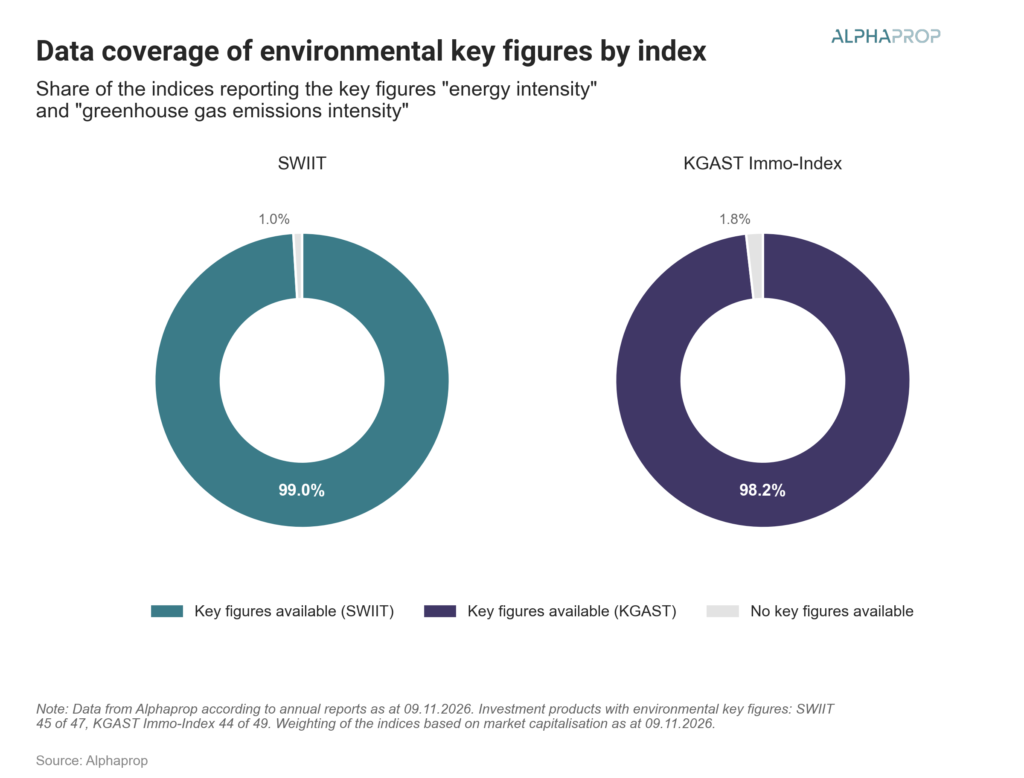
Environmental metrics are available for 45 of the 47 funds in the SWIIT (99.0% of the weighted index) and for 44 of the 49 investment groups in the KGAST Immo Index (98.2%).
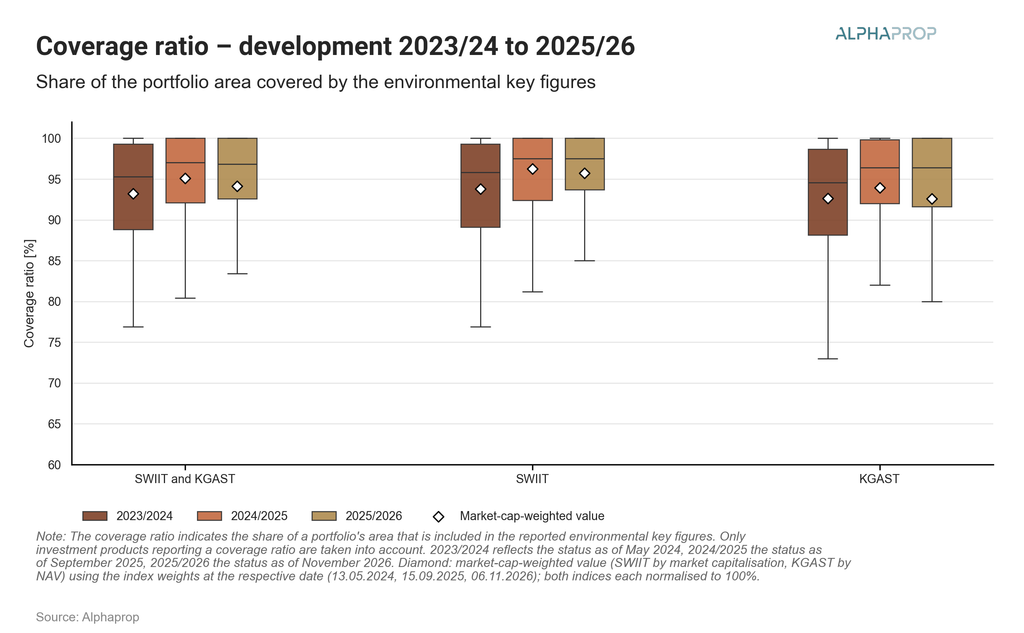
Coverage is also high within the portfolios. The coverage rate—the proportion of the portfolio area included in the KPIs—has a median of 97.5% (SWIIT) and 96.4% (KGAST). On a weighted basis, it is slightly lower at 95.7% and 92.6%, respectively: The larger products capture a slightly smaller portion of their area. Compared to 2023/2024, products with a low coverage rate have become less common.
REIDA is gaining acceptance—with some gaps in KGAST
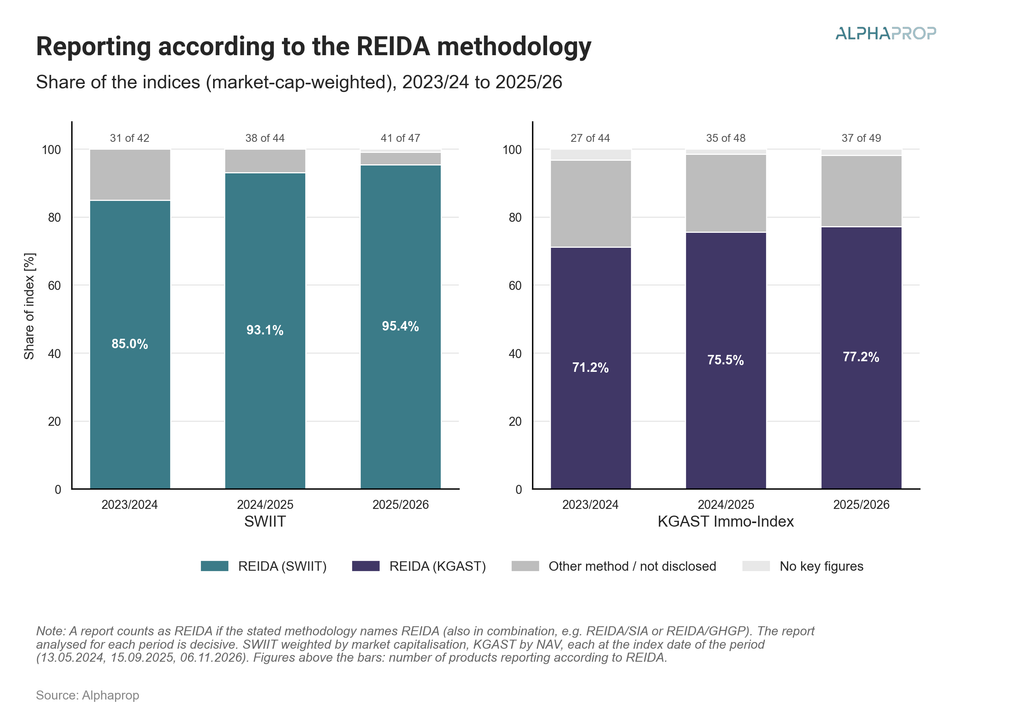
Reporting based on the REIDA methodology continues to gain traction: In the SWIIT, products accounting for 95.4% of market capitalization report according to REIDA (2023/2024: 85.0%, 2024/2025: 93.1%), and in the KGAST, 77.2% (2023/2024: 71.2%, 2024/2025: 75.5%). This means the SWIIT is almost entirely REIDA-compliant. Investment foundations do not always report this explicitly.
Usage Drives Energy Intensity
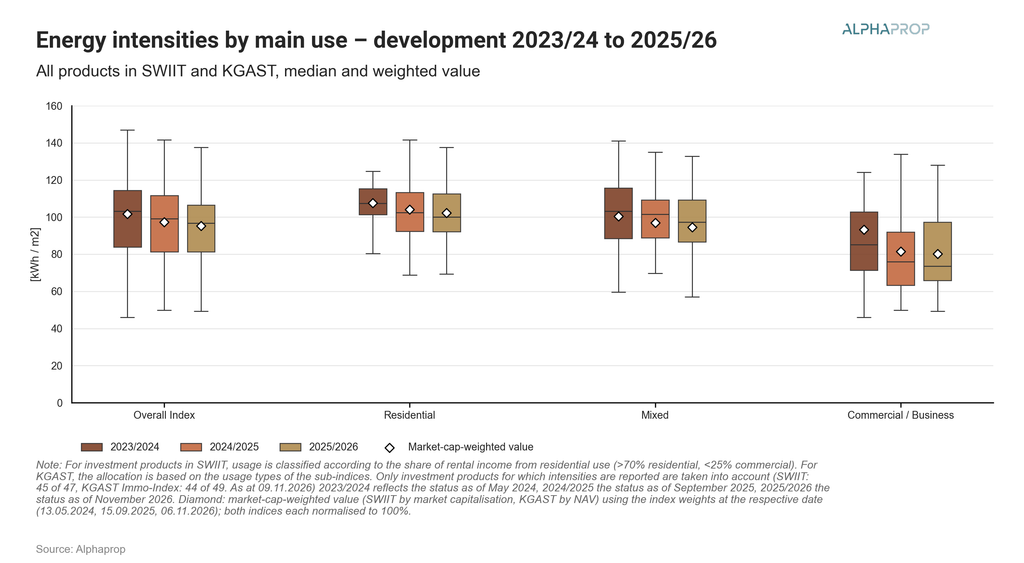
Energy intensity refers to owner-controlled energy consumption in relation to the energy reference area, including common areas.
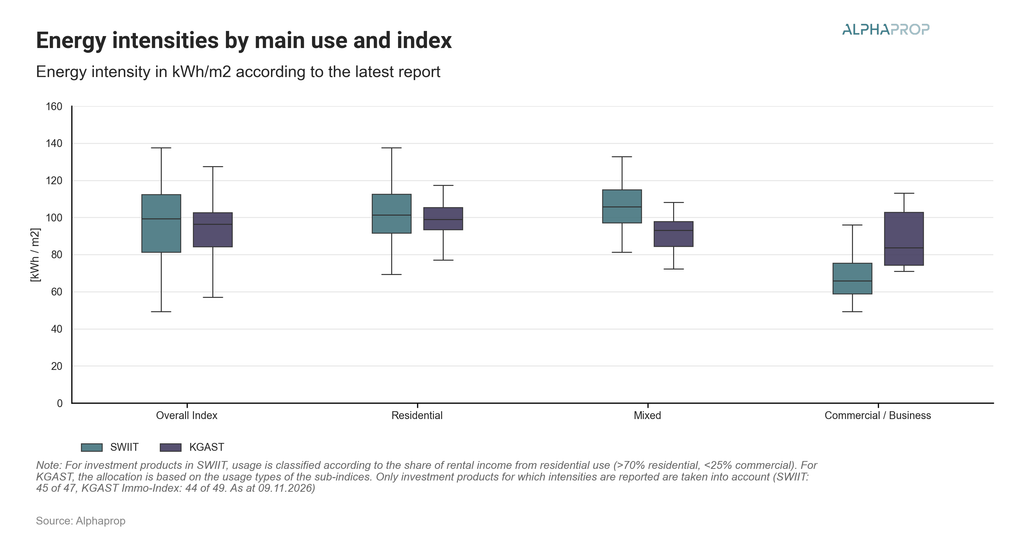
The median portfolio has an energy intensity of 99 kWh/m² according to the SWIIT and 96 kWh/m² according to the KGAST. Residential portfolios (median SWIIT 101, KGAST 99 kWh/m²) are significantly higher than commercial portfolios (SWIIT 66, KGAST 84 kWh/m²).
Over the last three periods, energy intensity has fallen steadily: Weighted across both indices, it has fallen from 101.7 kWh/m² (2023/2024) to 95.3 kWh/m² (2025/2026), and the median has decreased from 103.2 to 96.8 kWh/m².
Alphaprop automates your ESG reporting
- Automated Collection of Energy and Consumption Data
- Calculation of all environmentally relevant KPIs according to AMAS, KGAST, and ASIP
- Calculation of the CO₂ reduction pathway for individual properties or the entire portfolio
- Benchmarking using data from the Swiss indirect real estate investment universe
- Populating Templates for REIDA, GRESB, and Other Reports
- Analysis in an interactive dashboard
CO₂ Intensity Continues to Decline
Greenhouse gas emission intensity measures CO₂ equivalents per square meter of energy reference area. According to AMAS’s environmental KPIs, the focus is on the owner-controlled portion (Scope 1 and 2).
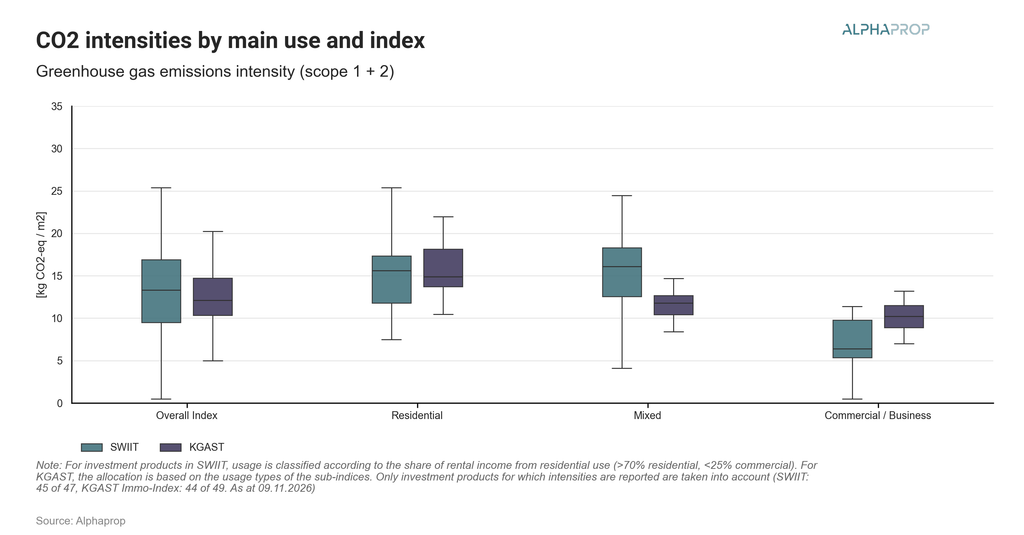
CO₂ intensities follow the same pattern as energy intensity: Residential portfolios have a median of 15.6 (SWIIT) and 14.9 kg CO₂e/m² (KGAST), respectively, while commercial portfolios have a median of 6.4 and 10.2 kg CO₂e/m², respectively.
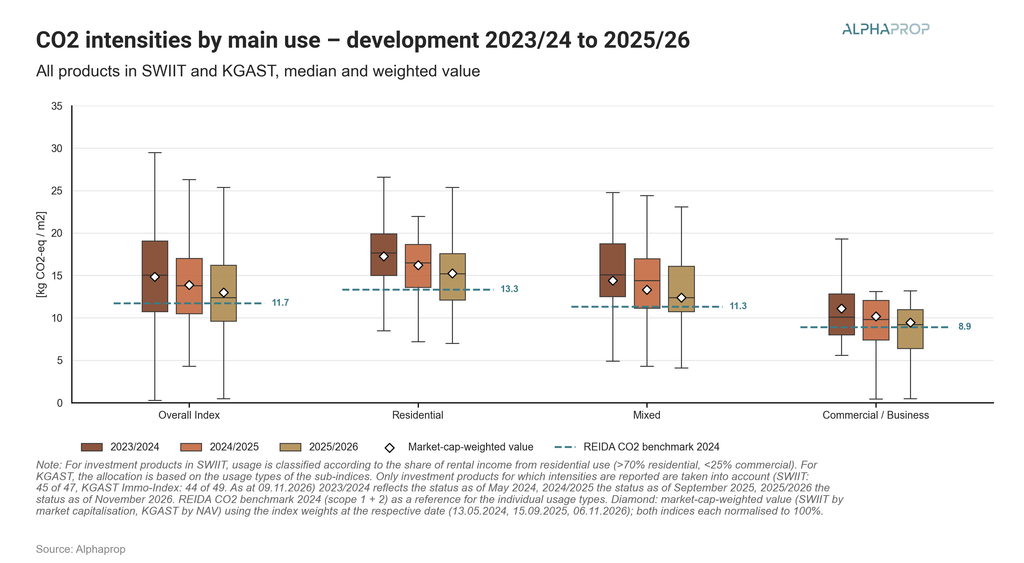
Over three periods, the weighted CO₂ intensity of both indices fell from 14.8 to 13.0 kg CO₂e/m². The REIDA 2024 benchmark stands at 11.7 kg CO₂e/m²; SWIIT and KGAST thus remain slightly above this weighted average across all property types.
Fossil fuels remain the majority of the energy mix
In addition to energy efficiency, replacing fossil fuels is crucial for achieving net-zero targets.
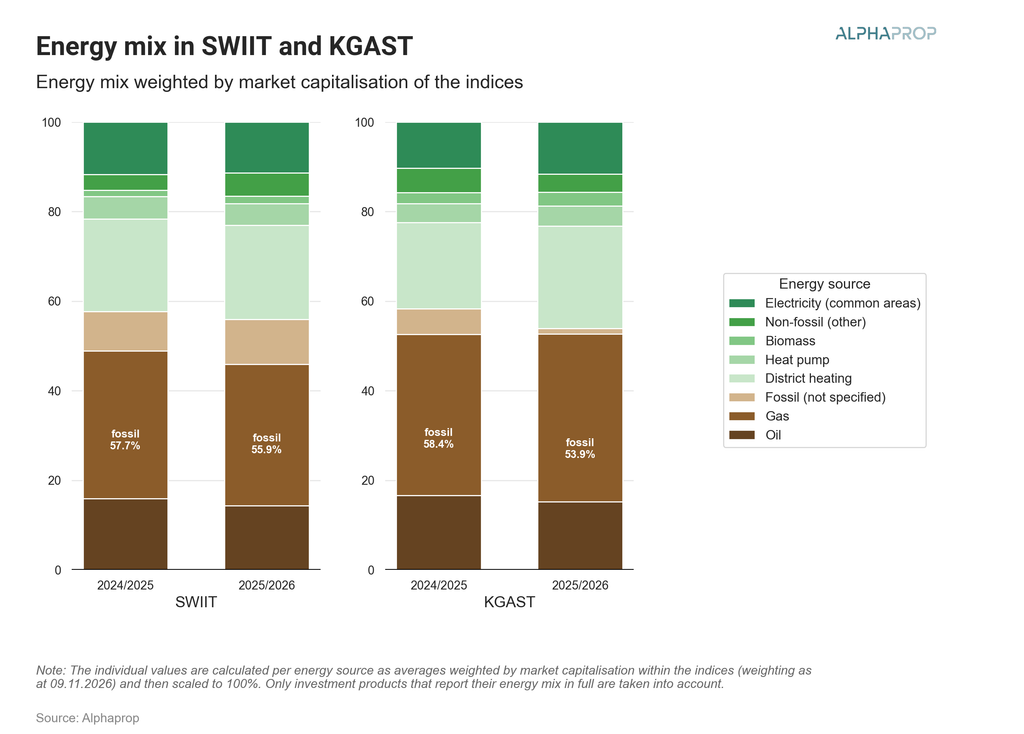
Compared to the previous period, both indices show a further shift toward non-fossil energy sources. The share of fossil fuels fell from 57.7% to 55.9% in the SWIIT and from 58.4% to 53.9% in the KGAST. The most significant driver is district heating, whose share in the KGAST rose from 19.2% to 22.9%.
Investment products on the decarbonization path
A decarbonization pathway shows how an investment product plans to reduce its CO₂ intensity by 2050. More and more products are explicitly setting their targets:
- 39 SWIIT funds and 36 KGAST investment groups have set a goal of achieving net-zero by 2050.
- Thirty-nine SWIIT and 34 KGAST products have set interim targets for 2030.
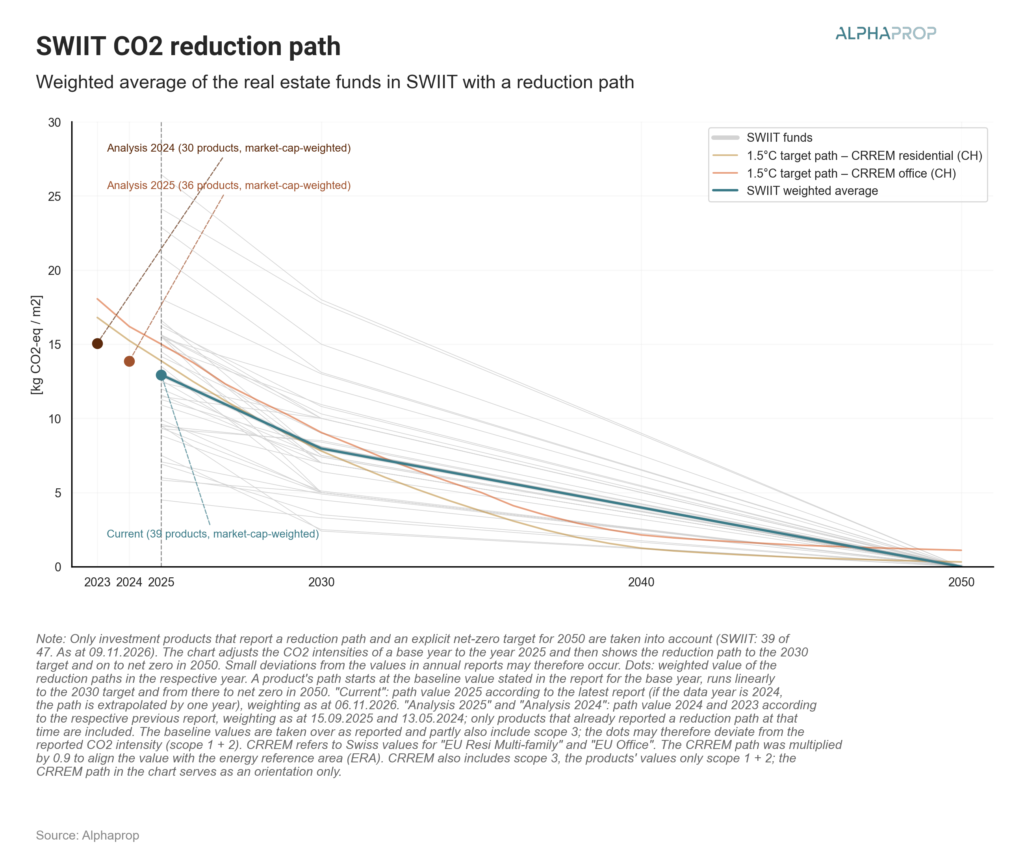
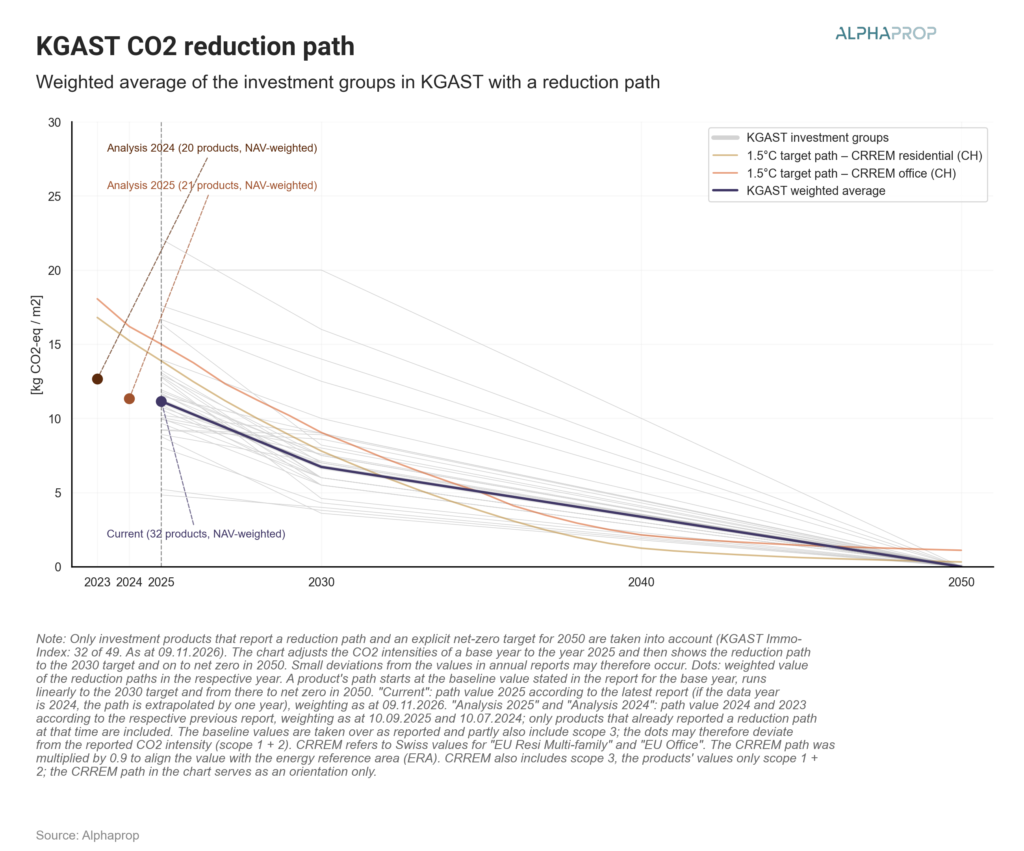
Since emission reduction pathways are not published in a machine-readable format, we represent them in a simplified manner: linearly from the reported baseline value to the 2030 target and on to net-zero by 2050. The weighted pathway values are thus modeled and are not directly comparable to the reported CO₂ intensities.
Both indices paint a similar picture: The weighted pathway value of the 39 SWIIT funds with a reduction pathway has fallen from 15.07 (2024 Analysis) to 13.86 (2025 analysis) to 12.94 kg CO₂e/m², while that of the 32 KGAST investment groups has fallen from 12.65 to 11.33 and then to 11.15 kg CO₂e/m². For KGAST, the previous year’s figures are based on significantly fewer investment groups (20 and 21, respectively), as many decarbonization pathways were only recently published. By 2030, the products aim to achieve an average of 8.0 kg CO₂e/m² (SWIIT) and 6.7 kg CO₂e/m² (KGAST), respectively. The SWIIT thus falls between, and the KGAST below, the CRREM 1.5°C values for residential and office properties (7.8 and 9.1 kg CO₂e/m², respectively). However, the CRREM value is only comparable to a limited extent, as it also includes tenant-controlled energy.
Sustainability in the Fund Prospectus
We have recently analyzed the fund prospectuses (including the fund agreement and investment regulations) of all 47 listed real estate funds in the SWIIT. The most recent prospectus is used as the basis for each evaluation: 44 of the 47 prospectuses are from 2026, while the remaining ones are from 2024 and 2025. The KGAST investment groups are not included in this analysis. Weights are based on market capitalization (as of November 6, 2026).
Sustainability criteria according to AMAS
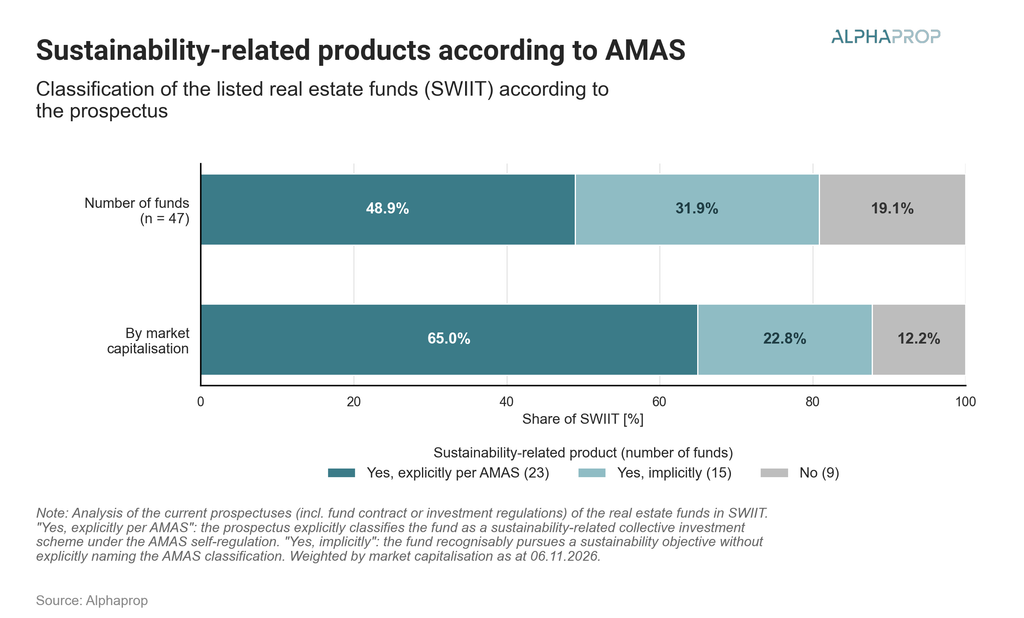
Just under half of the funds (23 out of 47) explicitly describe themselves in their prospectuses as collective investment schemes with a sustainability focus in accordance with the AMAS self-regulatory framework; in terms of market capitalization, this figure is 65.0%. Another 15 funds (22.8%) clearly pursue a sustainability objective without mentioning the AMAS classification. Nine funds (12.2%) do not position themselves as sustainable—some explicitly distance themselves from the label, even though they publish environmental metrics.
Quantitative Targets in the Prospectus
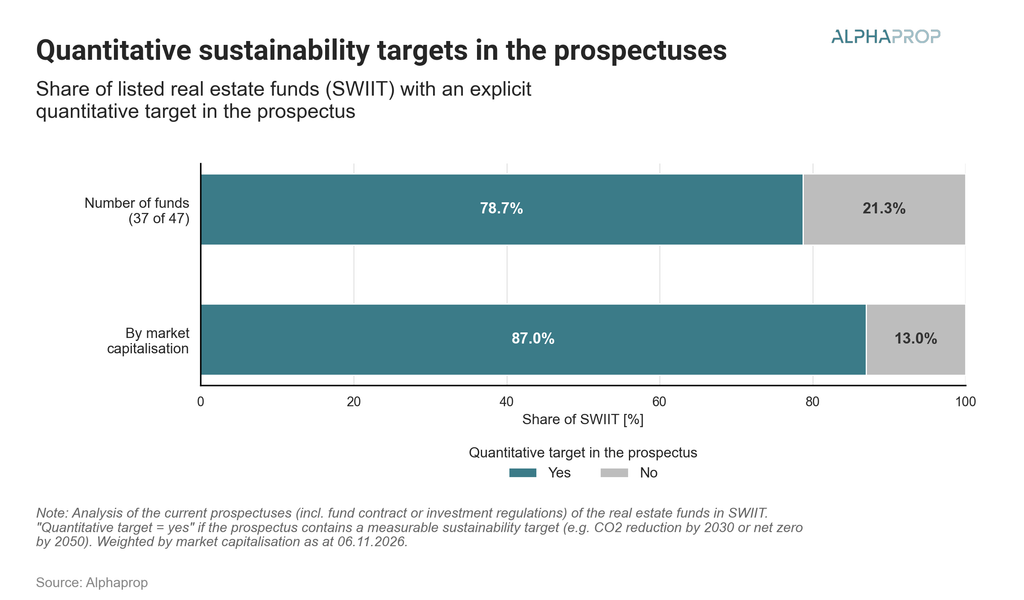
37 out of 47 funds (78.7%) explicitly state a quantitative sustainability target—such as a CO₂ reduction by 2030 or net-zero by 2050—in their prospectus; based on market capitalization, this figure rises to 87.0%.
Positive Trends, but Challenges Remain
The 2026 update confirms the trend of previous years: Data coverage is nearly complete, reporting in accordance with REIDA is becoming the norm, and both energy and CO₂ intensity have fallen once again. More products than in the previous year have set a net-zero target, and the vast majority of listed funds now also include their targets in their prospectuses.
However, with fossil fuels accounting for over 50% of energy sources, there is clearly still a need for action. Whether the reduction targets are met depends on whether the replacement of fossil-fuel-based heating systems proceeds at the planned pace in the coming years.