
Summary
- The data is in; now it’s time to take action: Nearly all real estate funds and investment foundations report environmentally relevant KPIs using a standardized methodology. The majority of listed funds now include their climate goals in their prospectuses.
- Audits will begin in 2026: The first mandatory audit period under the AMAS self-regulation framework has been in effect since April 1, 2026. Starting in 2029, the environmental KPIs of real estate funds with a sustainability focus will also be subject to mandatory audits.
- Greenwashing arises from the gap between promises and action: What matters is the overall communication strategy, not just the fund contract. The biggest weakness in practice is the documentation.
- The “S” in ESG becomes measurable: The SOSDA Benchmark compares the social performance of residential portfolios for the first time. About 80% of the apartments are considered affordable, but there is still room for improvement in the occupancy of larger apartments.
In just a few years, sustainability in indirect real estate investments has evolved from a voluntary add-on to a required component of product documentation. In the Alphaprop Insights webinar on October 28, 2026, we examined the topic from three perspectives: What do the data show, what do regulations require, and how can we measure not only the environmental but also the social dimension?
From a Patchwork to a Standard
Thomas Spycher, partner and co-founder of Alphaprop, opened the event with a retrospective. In 2021, when we at Alphaprop first attempted to systematically assess the sustainability of indirect real estate investments, the data landscape resembled a patchwork quilt: Individual products reported CO₂ figures, but how these were calculated often remained unclear.
A lot has happened in a short time since then. The AMAS circular on environmentally relevant KPIs marked the start of standardized reporting, followed by best practices and the new self-regulatory framework. The REIDA methodology ensures that the industry now uniformly converts energy consumption into CO₂ equivalents. For investors and analysts, this means the data is available and comparable.
The results of the latest analysis show just how far the industry has come along this path:
- The KPIs are available almost in their entirety, and the REIDA standard has become established.
- Energy and CO₂ intensity are declining, but the share of fossil fuels in the energy mix remains above 50%.
- An increasing number of products are publishing a reduction pathway and explicitly stating their targets in legally binding documents such as the prospectus or the fund contract.
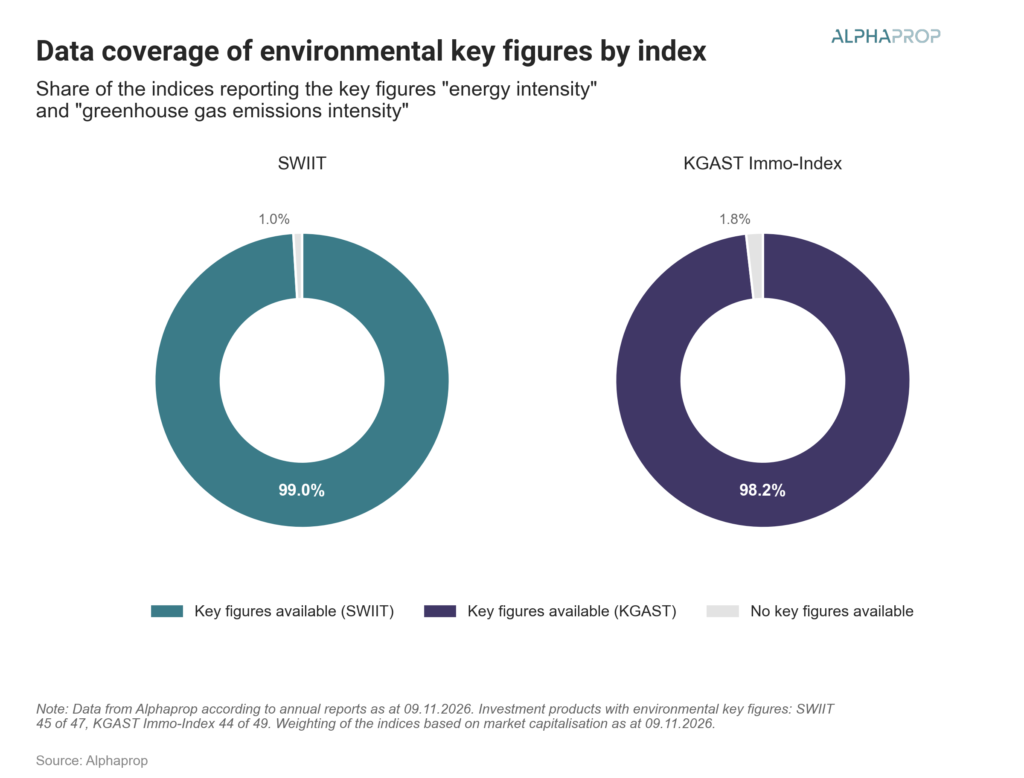
All the figures in detail: You can find the complete analysis of data coverage, energy and CO₂ intensity, energy mix, decarbonization pathways, and fund prospectuses here.
When is a real estate fund considered sustainable?
Dr. Heidi Gysi, Head of Sustainable Finance Law at EY, assists financial institutions in implementing sustainability regulations and is increasingly serving as an auditor as well. Her presentation focused on a tension that is particularly pronounced in the real estate sector: A sustainability goal can be quickly incorporated into a prospectus, but its implementation takes years. Heating system replacements and energy-efficiency retrofits involve long investment cycles, and unlike a securities portfolio, a real estate portfolio cannot be restructured overnight. Her key message: Sustainability is not a matter of nice-sounding phrases, but rather a transparent chain that extends from goals through measures and data all the way to reporting.
The AMAS self-regulatory framework governs when a fund may call itself sustainable. In addition to financial objectives, a sustainability objective is required that applies to at least 70% of the fund’s assets and is measured against clear indicators. This can be a strategic direction—such as a decarbonization pathway to net zero—or a targeted impact, such as affordable housing. ESG integration or exclusions alone are not sufficient. Thus, the regulation specifically addresses the other two topics covered in the webinar: decarbonization pathways and social impact.
Greenwashing: It’s the big picture that counts
Greenwashing occurs when a product promises more than it delivers. What matters here is not just the fund contract, but everything that investors see: fact sheets, websites, presentations, and sustainability reports. Heidi Gysi cited two typical examples:
- An Ambitious Path Without Guidance: A fund publishes an ambitious decarbonization path but has never clarified internally what happens to that path in the event of a new purchase, a sale, or missing consumption data.
- Window Dressing: A fund reports in detail on its heating replacement projects but fails to disclose how small a portion of the portfolio they represent. None of the numbers are wrong, and yet the picture is skewed.
Conversely, it is entirely legitimate to deliberately choose not to position oneself as sustainable, even if one publishes environmental metrics. However, this must then be clearly disclosed. The fact that some funds are taking this approach is already evident in the market.
The Audit Roadmap
For sustainability-related funds as defined by AMAS, a distinction must be made between two types of audits. In the first, the auditors do not assess whether a fund is “truly sustainable,” but rather whether its commitments align with its implementation: If a decarbonization pathway is specified in the fund agreement, it must be reflected in the remediation plan, controls, and reporting. In the second assessment, the environmentally relevant KPIs themselves are examined. Entities that obtain data from external managers remain responsible for ensuring its accuracy.
- April 2026: The first mandatory testing period begins. The requirement is therefore already in effect, even though no testing has taken place yet.
- 2027: The first audits are expected to take place in the second or third quarter.
- Starting in 2029: The reporting of environmental KPIs—including their calculation—will also become mandatory. Until then, it remains voluntary.
When asked by someone in the audience where the biggest problems arise in practice, Heidi Gysis’s answer was clear: documentation. Only what is documented can be reviewed—for example, how to handle data gaps or what happens when assumptions change. Her advice: don’t wait for the audit. The audit program is publicly available, and a dry run reveals early on where documentation is missing.
Alphaprop automates your ESG reporting
- Automated Collection of Energy and Consumption Data
- Calculation of all environmentally relevant KPIs according to AMAS, KGAST, and ASIP
- Calculation of the CO₂ reduction pathway for individual properties or the entire portfolio
- Benchmarking using data from the Swiss indirect real estate investment universe
- Populating Templates for REIDA, GRESB, and Other Reports
- Analysis in an interactive dashboard
SOSDA: Making Social Performance Measurable
Julia Häcki, Head of Sustainability at Immofonds Asset Management and President of the newly founded association SOSDA, presented the first Swiss benchmark for the social performance of real estate portfolios. While the “E” in ESG is now largely standardized, comparable figures for the “S” have been lacking until now. SOSDA aims to close precisely this gap.
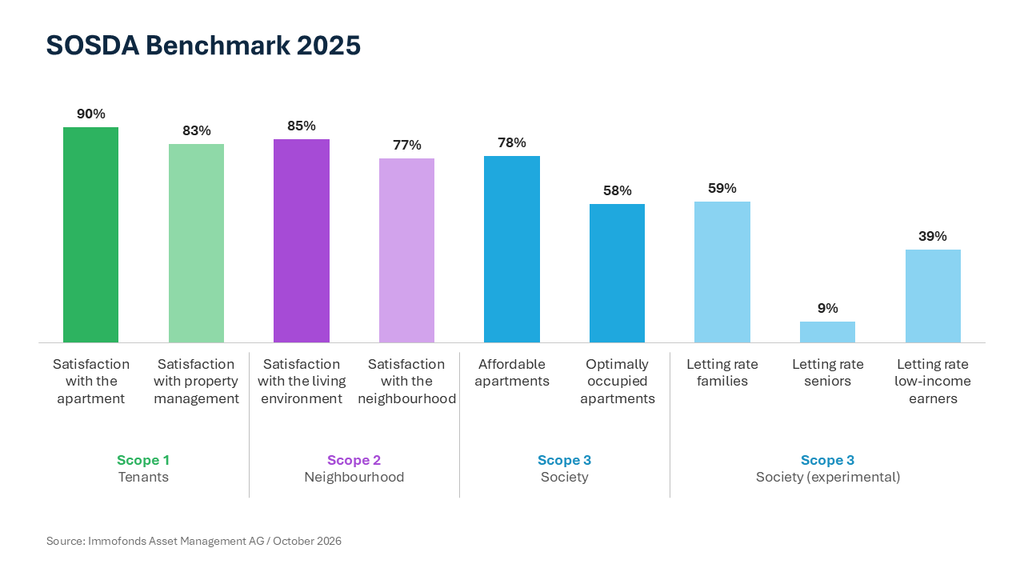
For real estate investment funds, nearly 80% of whose portfolios are invested in residential properties, the motivation was clear: In the heated debate over the housing market, there are many claims but little data. The goal of SOSDA was to provide facts. The benchmark measures performance on three levels, similar to a greenhouse gas assessment: among tenants, in the neighborhood, and in society.
The Initial Results
The first benchmark includes data from 17 female owners and paints a picture of institutional owners that dispels many preconceptions:
- Satisfaction: 80 to 90 percent of tenants are satisfied with their apartment, the property management, and the neighborhood.
- Affordability: Just under 80% of apartments are considered affordable, based on the median income of the respective municipality.
- Occupancy: There is room for improvement here. Only just under 60% of large apartments meet the rule of thumb that at least as many people live in them as there are rooms minus one.
From Benchmark to Action
SOSDA becomes particularly interesting when you compare your own scores against the benchmark. Immofonds did just that, published the results in its ESG report, and derived concrete action items from them—for example, regarding satisfaction with property management. The levers for improvement are very practical: When it comes to satisfaction, the focus is on property management—for example, in handling damage reports or building maintenance. Regarding occupancy, a leasing policy that prioritizes renting family apartments to families can help.
Getting started is easy: existing tenant surveys and a housing inventory are all that’s needed. The more owners who participate, the more meaningful the benchmark becomes, and the more objectively we can discuss affordable housing.
Conclusion: From Ambition to Evidence
The three presentations illustrate the same trend from different perspectives. The data set is broad and comparable, and targets are increasingly being set out in binding documents. With mandatory audits beginning in 2026, the focus shifts from ambition to verification: What is stated in the prospectus must be reflected in processes, data, and documentation. At the same time, SOSDA makes the social dimension measurable and thus comparable.
For fund management companies and asset managers, this means: Now is the right time to review their own implementation chain—from objectives to KPIs—to ensure it is verifiable.
We would like to extend our sincere thanks to Dr. Heidi Gysi and Julia Häcki for their contributions, and to all participants for their thought-provoking questions.